

December 2026 Lunch - Patricia Rodrigues

730 17th Street B1
Denver, CO 80202
United States
Tickets
Join us for a hybrid lunch in December
WEDNESDAY, December 2, 2026
JOIN US IN PERSON OR oNLINE
Talk Title: A Geology-Anchored, Two-Stage Workflow for Basin-Scale Well Log Normalization Using Statistical Volumes
Speaker: Patricia Rodrigues, SiesPetro Geoconsulting
Modern reservoir characterization increasingly depends on the integration of well logs, seismic data, geological interpretations, and production information. Yet, despite the abundance of digital well logs in the Permian Basin, creating coherent regional datasets remains challenging. Variations in acquisition vintages, service companies, borehole conditions, casing programs, and processing workflows introduce significant non-geologic variability that obscures geological trends. These challenges become particularly severe when normalizing entire wells rather than isolated target intervals, as wells often contain multiple casing strings, incomplete depth coverage, and intervals acquired under different conditions.
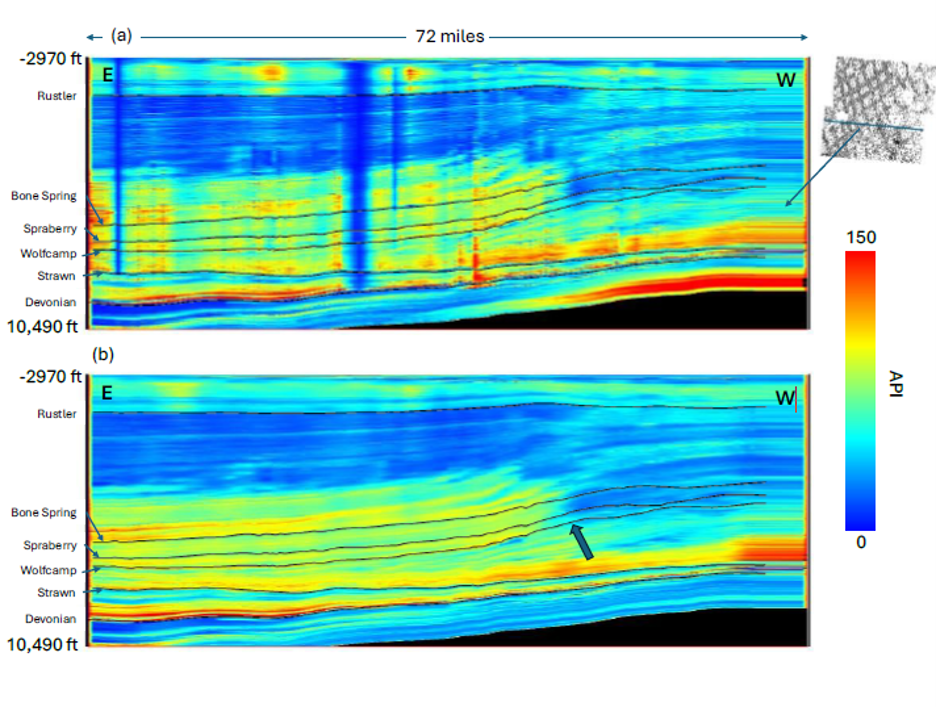
This study presents a workflow that normalized more than 26,000 gamma ray (GR) logs from surface to total depth (TD) across approximately 3,900 square miles and four counties in the Midland Basin, Texas, in less than two months. A carefully selected reference dataset was used to establish regional geological trends (2,700+ wells), which were then propagated through a volumetric normalization framework based on calibrated 3D statistical models. The workflow requires a limited number of key stratigraphic tops in the reference dataset to define the regional geological trends and establish a stratigraphic framework; whereas only casing-point information is needed for all wells in the study area. Once established, the normalization statistical framework was subsequently applied to more than 24,000 additional wells with only a few hours of computation, demonstrating a level of scalability that is difficult to achieve using traditional normalization workflows.
The resulting normalized dataset preserves regional geological trends while reducing non-geologic variability associated with casing effects, acquisition vintages, service companies, borehole conditions, and processing workflows. The normalized logs exhibit improved stratigraphic continuity, clearer expression of regional geological patterns, and substantially reduced acquisition-related artifacts. More importantly, the workflow enables construction of high-resolution 3D log-property volumes from large well populations. These volumes allow well logs to be analyzed in a spatial context similar to seismic data, making it possible to visualize geological variability, stratigraphic architecture, and regional trends at scales that are difficult to achieve through conventional well-to-well cross-sections.
The methodology also establishes a foundation for workflows that extend beyond normalization itself. Normalized properties can be extracted along horizontal well trajectories, supporting geosteering and development studies. Because the approach is readily applicable to additional petrophysical logs, it enables the creation of multi-property 3D volumes that can ultimately be integrated with completion and production data to investigate controls on well performance. In addition, the resulting datasets provide the consistency and scale required for emerging AI and foundation-model workflows that seek to integrate logs, seismic, and geological information within a common subsurface framework.
The work demonstrates that log normalization can evolve from a well-by-well correction task into a basin-scale process that supports regional interpretation, 3D property modeling, development planning, and future data-driven subsurface workflows.
Biography:
Patricia E. Rodrigues received a Ph.D. in Geophysics from Colorado School of Mines and a B.S. and M.S. in Chemical Engineering from Universidad Simón Bolívar (Venezuela). She has more than 25 years of experience in the research, development, and application of reservoir characterization technologies, specializing in petrophysics, rock physics, and integrated reservoir studies for the oil and gas industry. Her career includes technical and leadership positions at PDVSA-Intevep, Tricon Geophysics, DRM Energy, iReservoir, Newfield Exploration, and Whiting Petroleum, where she served as Chief Petrophysicist and Director of Geology and Geophysics. Since 2020, she has been a Petrophysical and Geoscience Advisor at SeisPetro Geoconsulting. Her expertise includes advanced petrophysical modeling and multimineral analysis, as well as regional-scale petrophysical studies involving large datasets ranging from hundreds to tens of thousands of wells. She has taught multimineral analysis at Colorado School of Mines and is the instructor of the SPWLA Petrophysical Multimineral Analysis course. She has also served as Vice President of Technology and President of the Denver Well Log Society.
Hybrid luncheon schedule:
- 11:15am: In-person check-in opens
- 11:30: Lunch service begins
- 12:00pm: Online event opens
- 12:15pm: Talk begins
- 1:00pm: Talk/Q&A session ends; Online event closes
Hybrid Luncheon costs:
- Member Lunch: $35
- Non-Member Lunch: $40
- Walk-in without Lunch: $15
- Member Online: $10
- Non-member Online: $20
- Student online: Free
Refund policy:
If you need to cancel an in-person lunch registration for any reason, you must do so by 4:00pm on the Thursday before the Wednesday luncheon. Refunds will not be available after 4:00pm on the Thursday before the luncheon. If you are unable to attend, your luncheon registration is transferable to another RMAG member, or if you are a non-member your registration is transferable to whomever you wish. Refunds will not be issued for online talk registrations.
Sponsorship Opportunities:
Interested in supporting RMAG through the Luncheons? Sponsor the lunch, or run a specific advertisement during the slide show.


